Ramesh Khadka never imagined that a water supply scheme would one day become a turning point in his life.
Growing up in a low-income family in Bachela, Darma Rural Municipality–5, Salyan, Ramesh worked as a daily wage labourer to help support his family. His life took a devastating turn in 2074 BS when an accident while operating an excavator resulted in the loss of his left leg.
But losing a leg did not mean losing his determination to live, work and contribute to his community.
Today, Ramesh is the Treasurer of the Jugepani–Talchhare–Kaphalgaura Lift Water Supply and Sanitation Scheme in Darma Rural Municipality–5, implemented in partnership with the Sustainable WASH for All (SUSWA) project. Completed in FY 2081/82, the scheme provides improved water services to 188 households. For Ramesh, however, the scheme has provided something beyond water: it has helped restore his confidence, dignity and sense of purpose.
From a dream to a life-changing accident
Growing up in a financially struggling family, Ramesh worked as a daily wage labourer to support his household. One day, while watching an excavator operating near his home, he began thinking about becoming an excavator operator himself.
Curious about how he could learn the work, he approached an excavator operator, who advised him to start as a helper and learn gradually. Excited by the opportunity, Ramesh began working as an assistant operator.
Then, on 12 Falgun 2074 BS, everything changed.
While working, the excavator suddenly overturned. Ramesh lost consciousness and woke up in a hospital in Nepalgunj. His left leg was severely injured, with extensive damage to the bone and nerves. Doctors advised that he be taken to Kathmandu immediately.
With his family’s limited financial means, the prospect of treatment at an expensive hospital was overwhelming. For a time, Ramesh felt that his life had reached a dead end.
The accident changed his physical abilities, but it did not end his aspirations.
An opportunity to lead
Years later, Ramesh was given an opportunity that he initially found difficult to accept.
When the community began forming a Water Users and Sanitation Committee for the Jugepani–Talchhare–Kaphalgaura Lift Water Supply and Sanitation Scheme, members discussed the responsibilities and qualifications required for different positions. The community selected Ramesh as Treasurer.
He hesitated.
“How can someone like me manage such a large scheme?” he wondered.
With encouragement from the community, SUSWA’s WASH Facilitator Pushpa KC and other project staff, Ramesh agreed to take on the responsibility.
The project supported the newly formed 11-member committee through preparatory activities and capacity-development support. These opportunities gradually strengthened Ramesh’s confidence. He also received guidance on scheme management, financial procedures and coordination with different stakeholders.
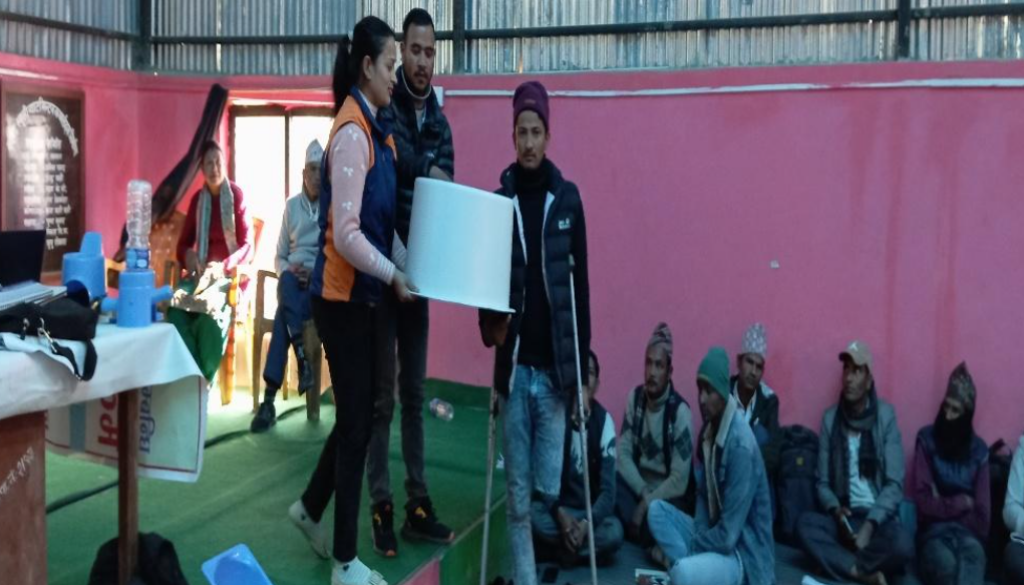
A three-day municipal-level training on construction material procurement and user committee management, held from 12–14 Poush 2080 BS, became another important milestone.
Meeting members of other user committees helped Ramesh realise that he was not alone in facing challenges. The training also included a session on Gender Equality, Disability and Social Inclusion (GEDSI), where he learned about legal provisions and opportunities available to people with disabilities.
For Ramesh, inclusion was no longer just a concept. It became something he could experience in his own life.
He also appreciated the availability of a user-friendly, accessible toilet with a commode, which made toilet use considerably easier for him.
From hesitation to leadership
The water supply scheme, with an investment of approximately NPR 12.8 million, required extensive coordination. Mobilising workers, coordinating with suppliers, working with skilled technicians, and communicating with project and local government representatives were among the responsibilities Ramesh took on.
The Chairperson of the user committee also had significant household responsibilities, which meant that Ramesh often took on additional responsibilities to keep the scheme moving.
Step by step, he gained the confidence to lead.
When questions were raised during the first social audit and monitoring process about whether the scheme could actually be completed, Ramesh stood firmly beside the Chairperson and supported the continuation of the work.
From the beginning of construction to its completion, he coordinated with workers, suppliers, community members and other stakeholders.
The result was a functioning water supply scheme benefiting 188 households.
For the community, Ramesh’s leadership became proof that disability does not prevent a person from taking responsibility or delivering results.
The workers involved in the scheme received their payments, while public reviews of expenditure at different stages strengthened community trust in the project and its management.
“Life still has to go on”
Ramesh’s resilience extends beyond the water scheme.
At one point, he feared that his disability would also cost him his relationship. His partner’s family had considered arranging her marriage elsewhere because they doubted whether Ramesh could support a family.
But she chose to stand by him.
Today, they are married and have two children. His wife runs a shop and a broiler chicken farm, while the couple also work together to process and sell chickens. When he has free time, Ramesh drives his own auto-rickshaw.
Laughing, he recalls how people once doubted whether he could support a family.
“They once took my wife away because they thought I could not support her. Now I am one of my in-laws’ favourite sons-in-law.”
For Ramesh, disability is not a reason to stop living.
“What can you do just because you have a disability? Life still has to go on. If you have determination, you can live your life like anyone else.”
Continuing to serve his community
Ramesh’s involvement with the water scheme did not end when construction was completed.
He continues to support the scheme’s sustainability by encouraging the Rural Maintenance Worker to collect monthly water tariffs and helping ensure that the system remains functional and financially sustainable.
His contribution demonstrates that meaningful participation does not end with infrastructure construction. When people are trusted, supported and given opportunities to lead, they can become important drivers of sustainable community services.
For Ramesh, the journey from a daily wage labourer to a respected community leader has been far from easy. He lost his leg, faced financial hardship and experienced discrimination and doubt. Yet, through determination, community support and an opportunity to lead, he rebuilt his confidence and found a new role in serving his community.
He credits the support and encouragement he received through the water supply project for helping him regain the confidence to take responsibility.
An opportunity can reveal hidden potential
Ramesh’s story is not only about one individual. It is a reminder that every community has people with different abilities, talents and potential. Sometimes, what they lack is not ability, but an opportunity to demonstrate it.
By promoting inclusion, removing barriers and creating space for people with disabilities to participate in decision-making and leadership, communities can unlock capabilities that might otherwise remain unseen.
Ramesh’s journey shows that disability does not define a person’s potential. When people are trusted, supported and given an opportunity, they can lead, contribute and create lasting change in their communities.