
- Background
Across rural Nepal, considerable investments have been made in expanding access to drinking water services. However, sustaining these investments remains an ongoing challenge. Many rural water supply schemes gradually experience reduced functionality due to delayed maintenance, limited financial resources, and the absence of institutional mechanisms that enable timely response to minor system failures.
Recognizing these challenges, the SuSWA Project adopted a systems-strengthening approach by supporting the establishment of Rural Water Supply Service Support Centers (SSCs) across its 28 partner local governments in Karnali Province. Rather than creating parallel implementation structures, the SSC model was designed to strengthen the institutional capacity of local governments to provide continuous technical, managerial, and financial support for rural water supply services.
Within this framework, Hima Rural Local governments successfully institutionalized a Repair and Maintenance (R&M) Fund Operational Guideline, creating a sustainable financing mechanism that enables timely maintenance while fostering greater ownership among Water User Committees (WUCs).
- The SSC Approach: Building Local Systems for Sustainable Service Delivery
The Rural Water Supply Service Support Center serves as the Local governments ‘s institutional platform for supporting the long-term functionality of rural water supply schemes. Through the SSC, municipalities are better equipped to:
- Provide continuous technical assistance to Water User Committees.
- Monitor the functionality status of water supply schemes.
- Coordinate preventive and corrective maintenance activities.
- Strengthen the capacity of community institutions.
- Mobilize municipal resources for operation and maintenance.
- Facilitate evidence-based decision-making for sustainable service delivery.
As part of this institutional strengthening process, the SuSWA Project provided technical facilitation to Hima Rural Local governments in developing, consulting, and endorsing the Repair and Maintenance Fund Operational Guideline. Importantly, the guideline was formally approved by the Rural Local governments, ensuring that the financing mechanism became part of the Local governments own governance and service delivery system.
- Institutionalizing the Repair and Maintenance Fund
The endorsed Operational Guideline introduced a transparent and accountable financing mechanism for minor repairs of community-managed water supply schemes.
The guideline established that:
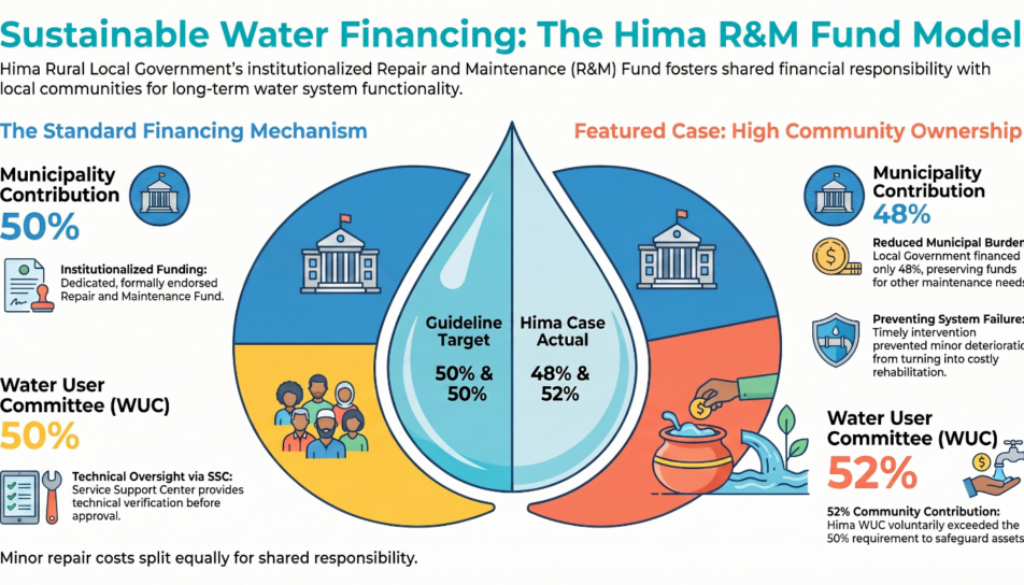
- Minor repair costs would normally be shared equally between the Rural Local governments and the respective Water User Committee.
- Municipal financial support would be mobilized through the dedicated Repair and Maintenance Fund.
- Water User Committees would manage repair activities with technical oversight from municipal technicians through the SSC.
- Financial support would be provided following technical verification and approval in accordance with the guideline.
This arrangement reinforces the principle that sustainable water services are a shared responsibility between local government and service users.
- The Experience
Following the operationalization of the Repair and Maintenance Fund, one community-managed water supply scheme required minor repairs after components of its distribution system deteriorated through regular use. Although the damage did not require major rehabilitation, timely intervention was essential to prevent further service disruption.
The Water User Committee reported the issue to the Local governments through the Service Support Center. A joint technical assessment confirmed the repair requirements and the Local governments approved financial support under the newly endorsed guideline.
While the guideline envisaged a 50/50 cost-sharing arrangement for the minor repair of the water supply schemes, the Water User Committee contributed 52 percent of the total repair cost, with the Rural Local governments financing the remaining 48 percent through the Repair and Maintenance Fund.
This voluntary contribution beyond the required threshold reflected the committee’s confidence in the institutional mechanism and its commitment to safeguarding community assets.
- Results
The repair was completed promptly, restoring reliable water service to the beneficiary households while preventing the deterioration of the scheme into a more costly rehabilitation requirement.
More importantly, the experience demonstrated several broader institutional outcomes:
- The operational guideline translated municipal policy into practical action.
- The SSC effectively functioned as the coordination mechanism linking communities, technical staff, and local government resources.
- The Repair and Maintenance Fund enabled timely response to maintenance needs.
- Community ownership was strengthened through shared financial responsibility.
- The Local governments demonstrated increased capacity to deliver post-construction support as a core local government function.
Beyond the successful repair itself, the initiative strengthened trust between the local government and Water User Committees, encouraging greater collaboration for future operation and maintenance activities.
- Why This Matters
The significance of this experience extends beyond a single repair intervention.
It demonstrates how institutional mechanisms can transform the sustainability of rural water services by shifting the focus from project-driven infrastructure development to locally led service delivery.
Rather than relying on external project financing for individual repairs, the SuSWA Project invested in strengthening municipal systems through the establishment of the Rural Water Supply Service Support Center and the development of enabling policies and procedures. As a result, Hima Rural Local governments now possess an institutional mechanism capable of supporting water supply functionality beyond the lifespan of the project.
The willingness of a Water User Committee to contribute more than the prescribed community share illustrates that transparent governance, predictable financing mechanisms, and responsive local institutions can significantly enhance community ownership.
- Key Lessons
Several important lessons emerge from this experience:
- Sustainable rural water services require strong local institutions as much as physical infrastructure.
- The Rural Water Supply Service Support Center provides an effective institutional platform for coordinating post-construction support.
- Operational guidelines help translate policy commitments into consistent municipal practice.
- Cost-sharing mechanisms strengthen accountability and promote shared ownership between local governments and communities.
- Communities are more willing to invest in maintaining their water systems when local governments provide transparent, predictable, and responsive support.
- Development partners can achieve lasting impact by strengthening local government systems rather than directly financing service delivery.
- Conclusion
The experience of Hima Rural Local governments demonstrates how institutional strengthening can enhance the sustainability of rural water supply services. Facilitated by the SuSWA Project, the establishment of the Rural Water Supply Service Support Center (SSC) and the endorsement of the Repair and Maintenance Fund Operational Guideline have created a practical and locally owned mechanism for supporting the functionality of community-managed water supply schemes.
The successful repair of a water supply scheme—where the Water User Committee voluntarily contributed 52 percent of the repair cost—reflects more than effective cost-sharing. It illustrates growing community confidence in municipal systems, strengthened local ownership, and the value of embedding post-construction support within local government institutions.
As one of the 28 local governments in Karnali Province implementing the SSC approach, Hima Rural Local governments offer a promising example of how institutionalized service support mechanisms can contribute to more resilient, functional, and sustainable rural water services. This experience provides valuable learning for other local governments seeking to strengthen post-construction support through locally owned and system-based approaches.
Infographic